What you’ll do in Stohb
- Choose a consistent report period.
- Read sales, cost and margin together.
- Check billed, paid and outstanding amounts.
Follow the screens using your own business details. The screenshots were captured in the actual Stohb apps with local guide examples. Prices, customers and results shown are illustrative.
Read the money behind a sale in Stohb Central
For a useful report, record the sale and its payments accurately and complete the appropriate handover. Our example is isolated to Guide Studio.
1. Choose the report’s location and dates
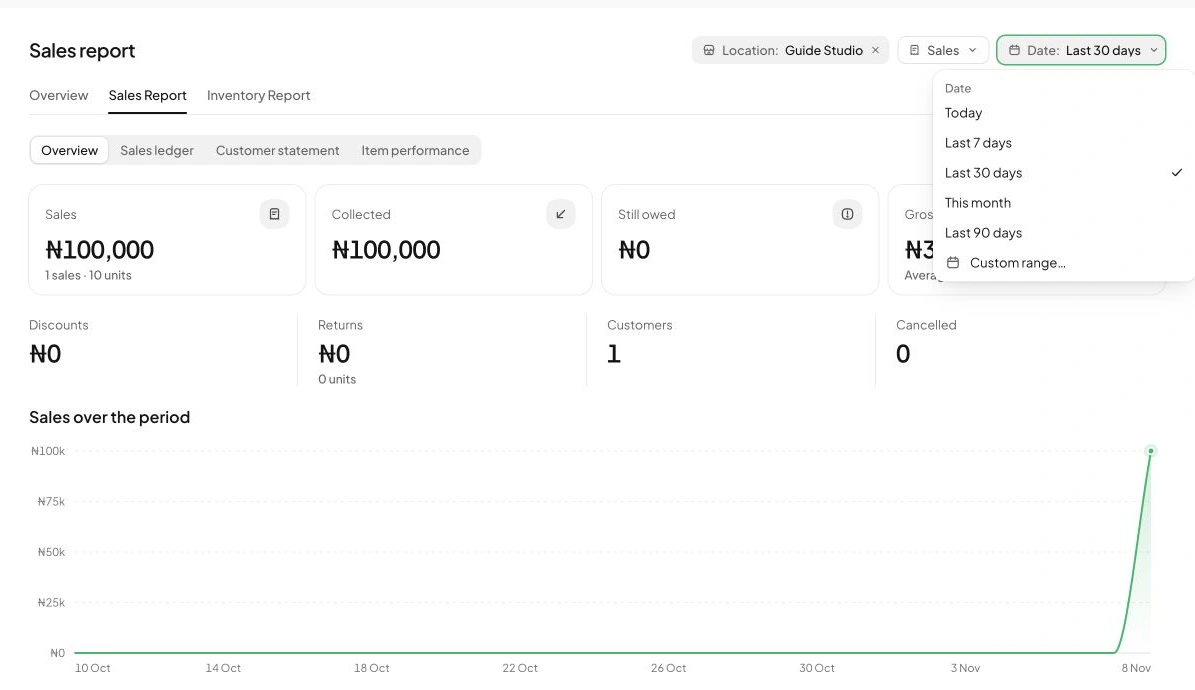
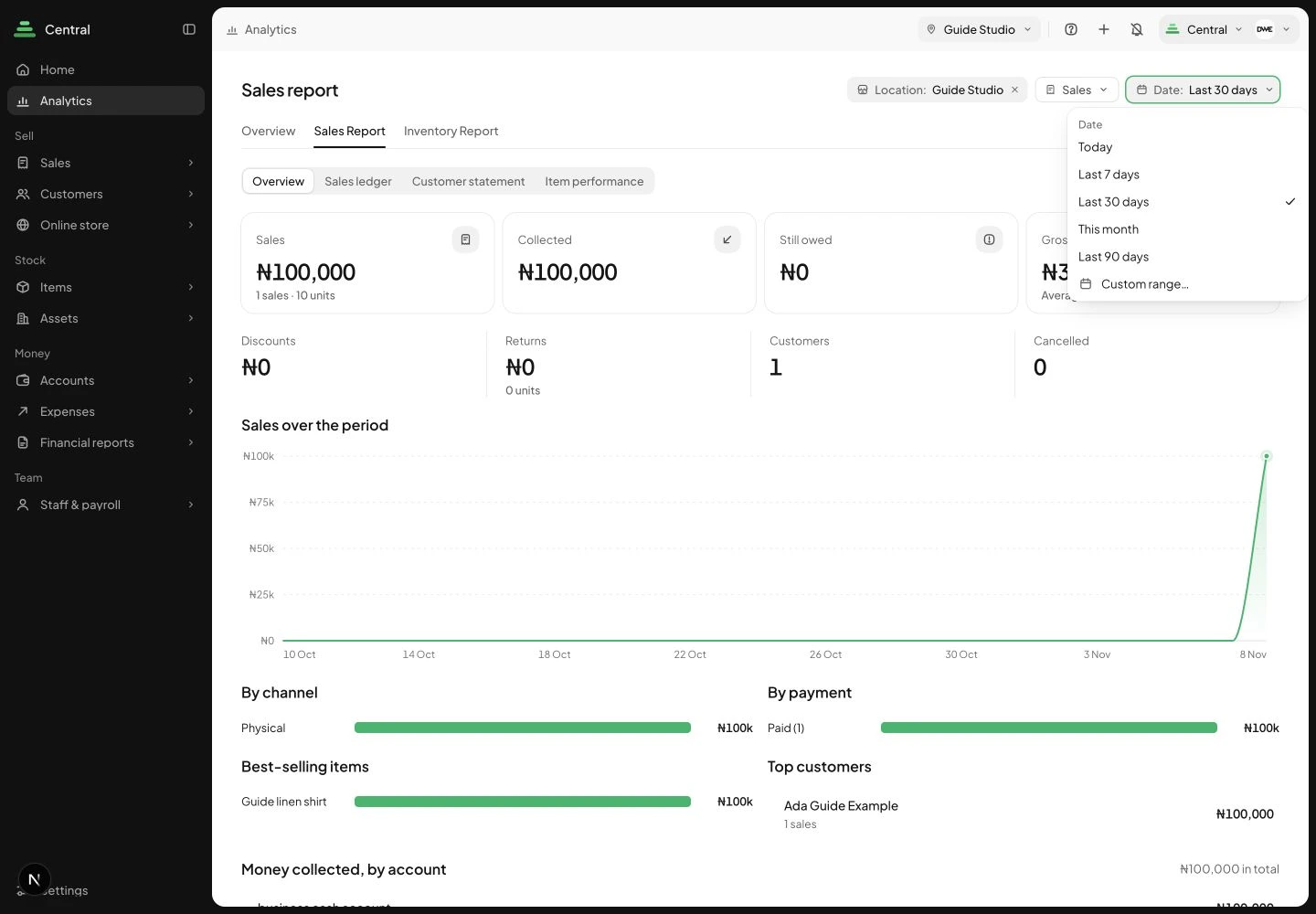
Open Analytics, then Sales Report. Use the Location control within the report, not only the location shown in the app header. Choose the period you want to understand. Our screenshots use Guide Studio and Today. A report for all locations would answer a different question and include unrelated activity.
 Enlarge screenshot
The report’s own location and date controls. Check the result: You are reading the intended activity for a stated period and location.
2. Read the overview as separate questions
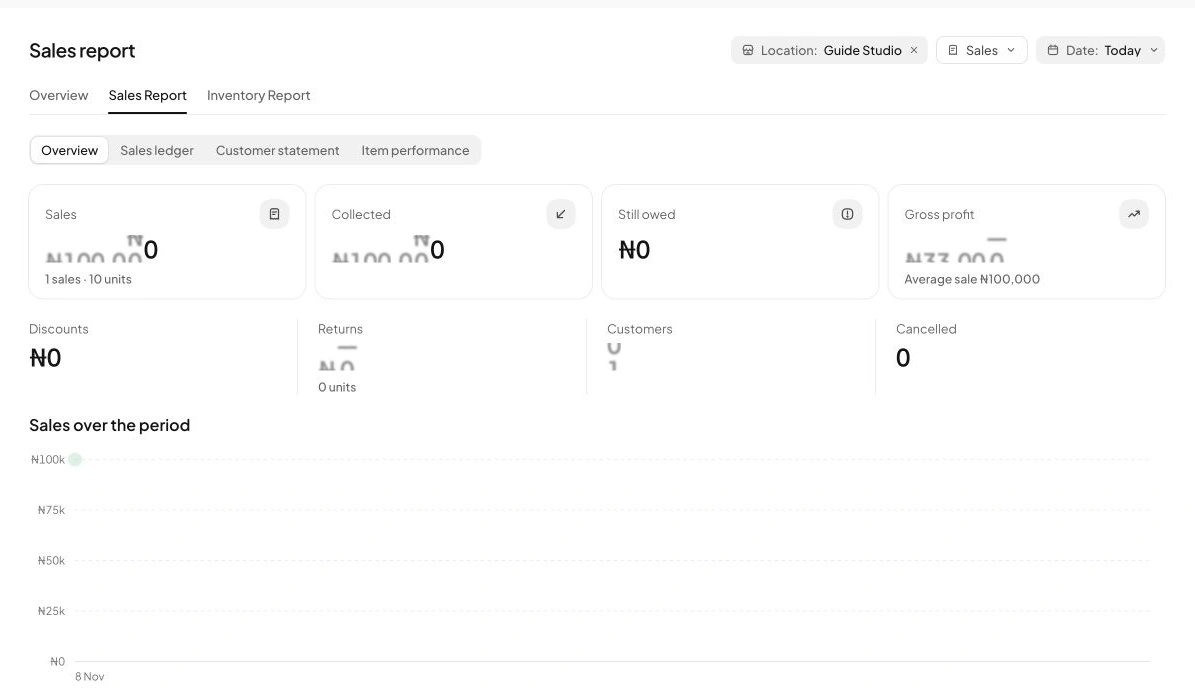
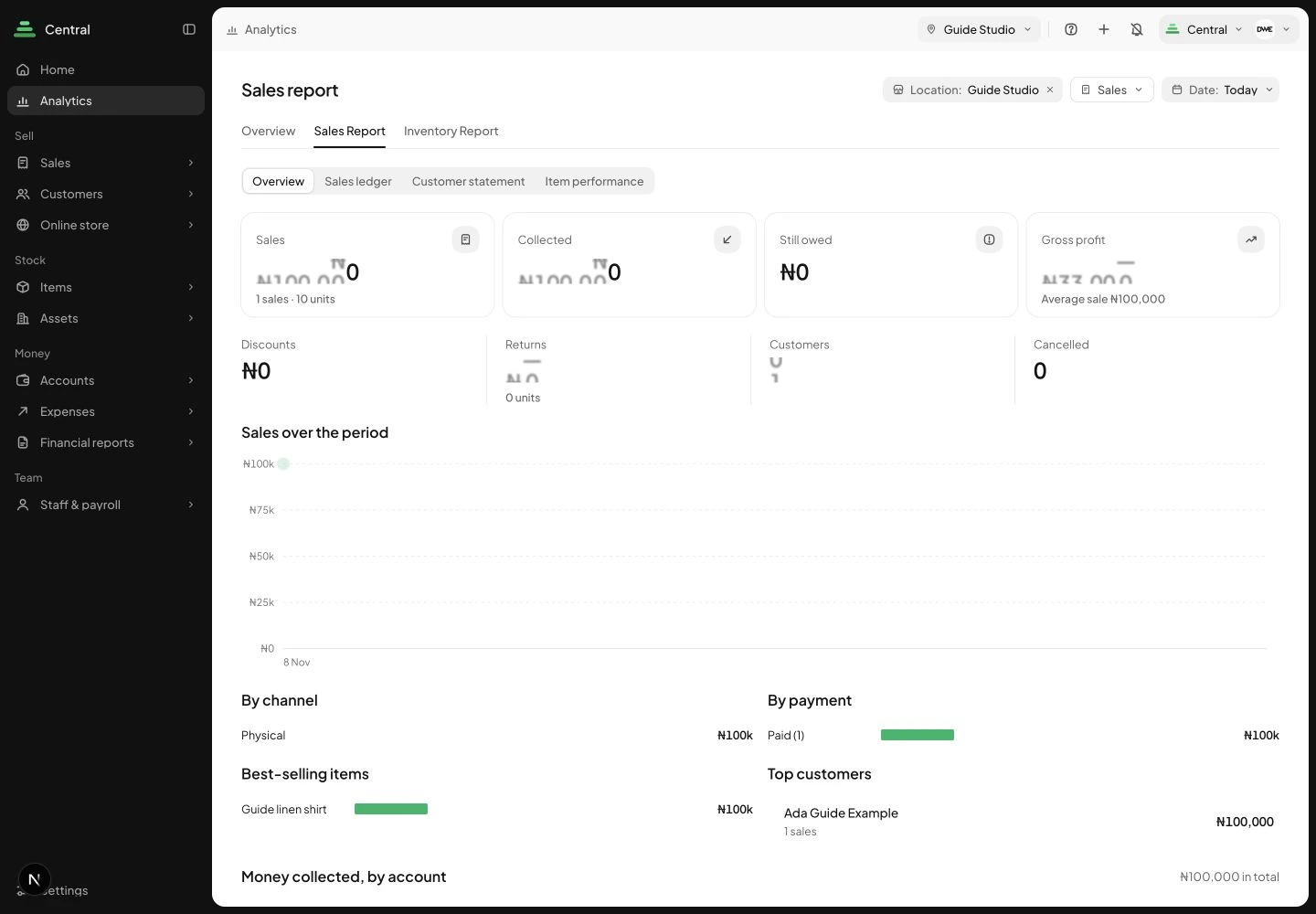
Overview shows Sales, Collected, Still owed and Gross profit. In the completed example, sales and collected money are both ₦100,000, nothing is owed, and gross profit is ₦33,000. Earlier in the same order we had collected ₦60,000 with ₦40,000 still owed. Stohb keeps those questions visible rather than forcing you to treat every sales total as available cash.
 Enlarge screenshot
The actual overview after the example sale was fully paid and handed over. Check the result: You can distinguish the sales value, customer receipts and remaining balance.
3. Check the underlying sale in the ledger
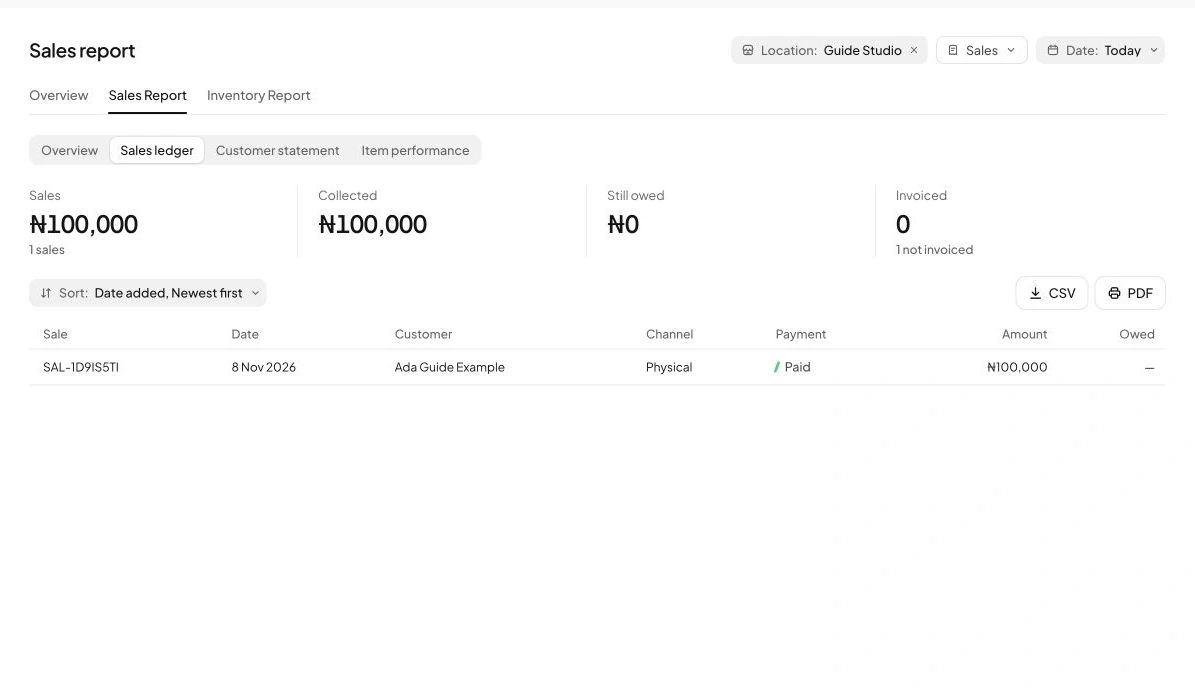
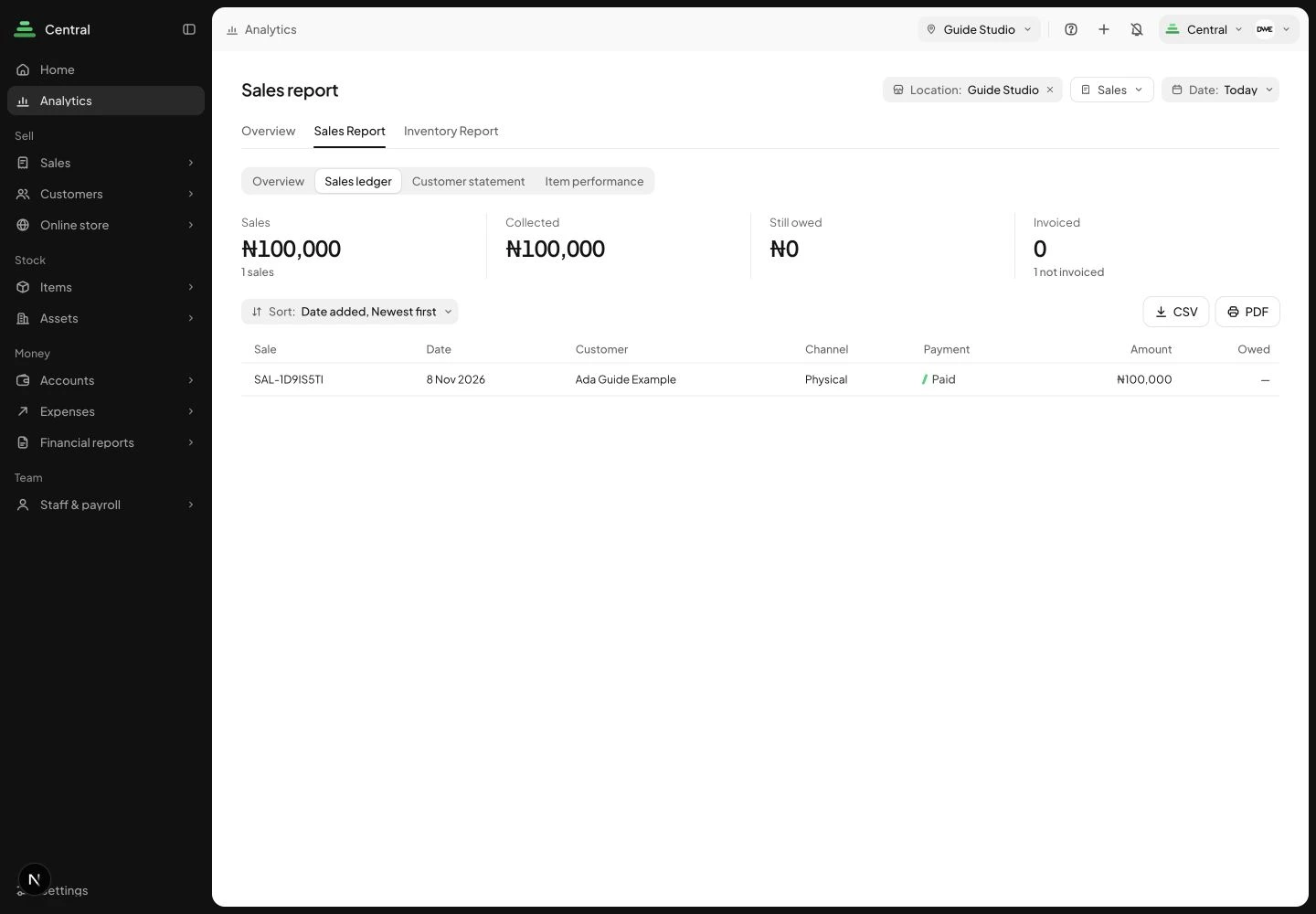
Choose Sales ledger to find the individual sale, its date, customer, payment state, amount and owed balance. The example reference is SAL-1D9IS5TI. If a total looks surprising, inspect its records instead of assuming a dashboard number tells the whole story. CSV and PDF actions are available in this ledger view.
 Enlarge screenshot
The real sales ledger showing the single guide transaction. Check the result: The overall figures can be connected to a specific saved sale.
4. Check cost of goods in Item performance
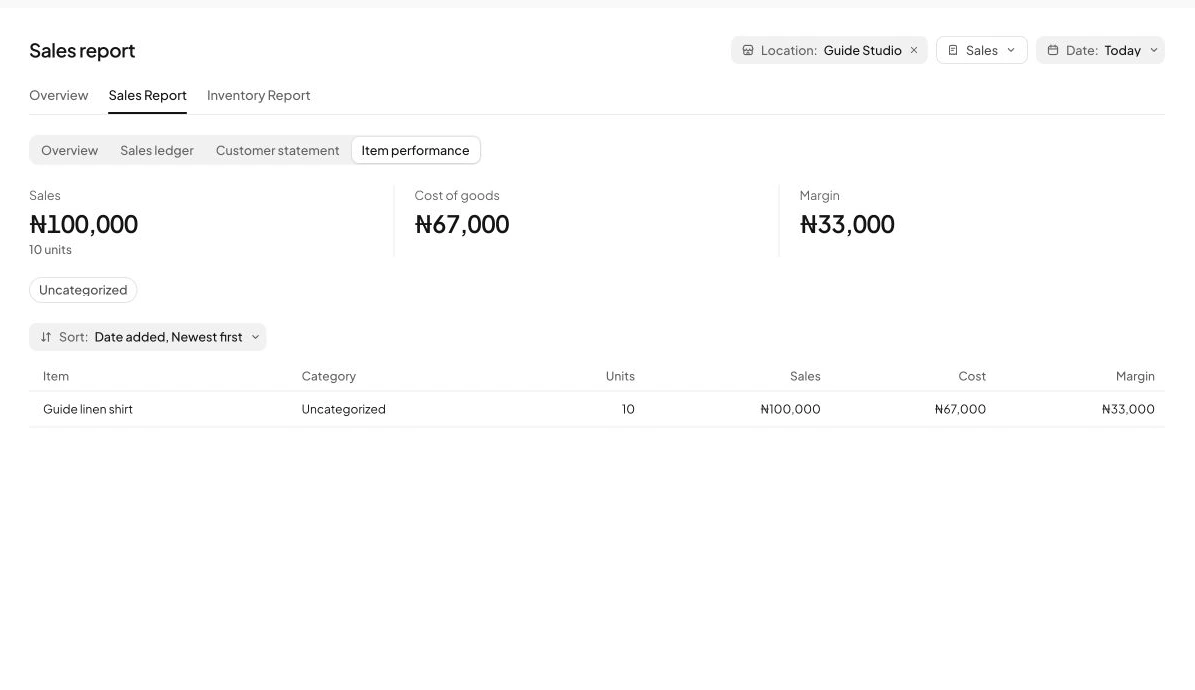
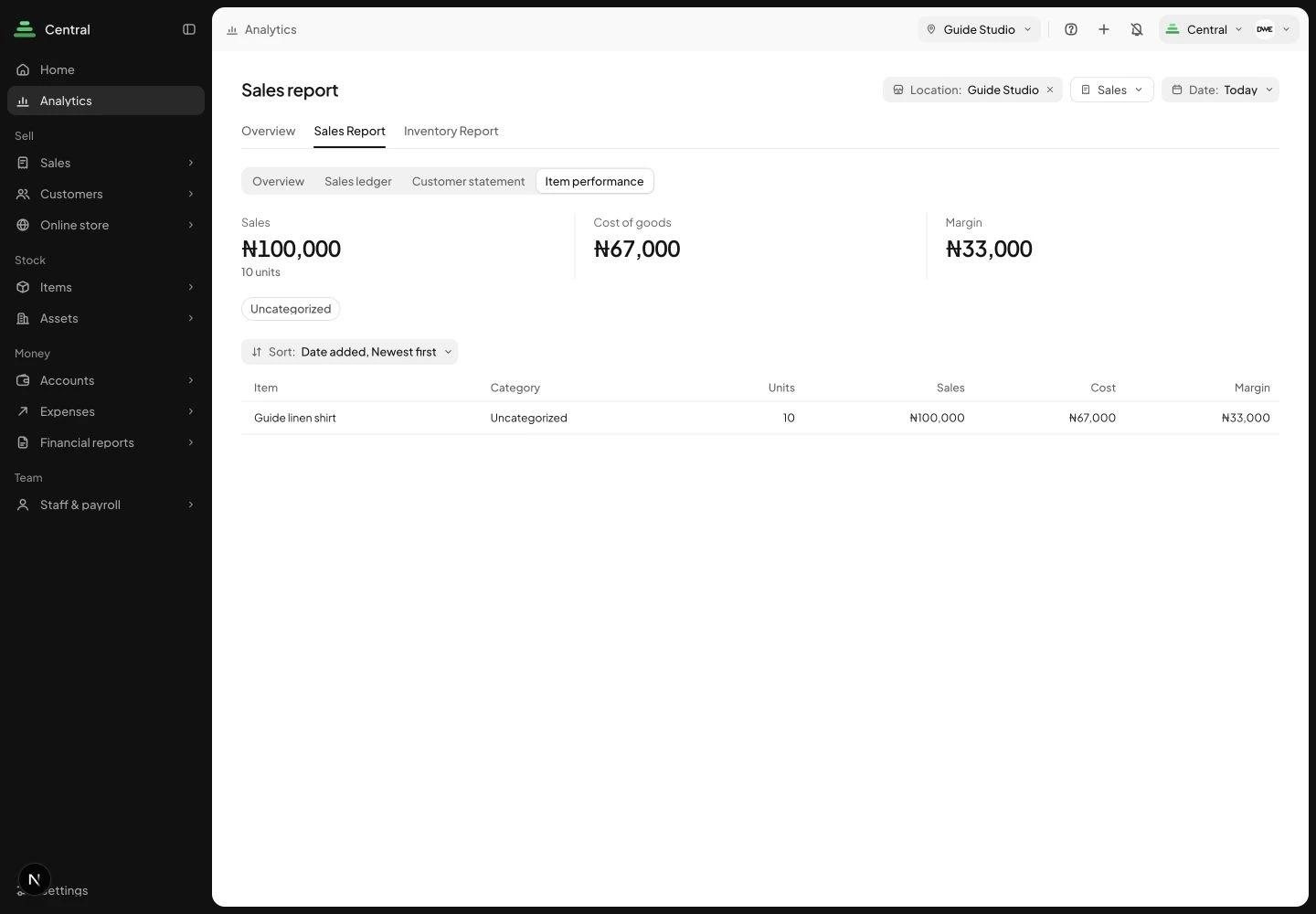
Open Item performance. Our ten units show ₦100,000 sales, ₦67,000 cost of goods and ₦33,000 margin. This matches the ₦6,700 recorded unit cost. Goods cost was recorded when we completed handover, so an unfinished sale should not be interpreted as though every stock cost has already posted. Other business expenses still need to be considered before calling this net profit.
 Enlarge screenshot
The actual item row and totals after handover recorded stock cost. Check the result: You can explain the recorded goods margin without calling it final business profit.
Understand the decisions behind the steps
The app keeps the record useful. These explanations help you decide what to enter and how to interpret what Stohb shows.
Revenue answers what you sold
Revenue describes sales over a period under the accounting basis being used. For this worked example, we count an agreed completed sale when it is recorded, even if part of the customer’s payment is still outstanding. Your own reporting treatment should be understood before comparing figures.
Suppose a fictional shop sells ten units at ₦10,000 each. Sales value is ₦100,000. That number tells you the value of the goods sold. It does not yet tell you what those goods cost, what the shop spent on running the business or how much cash has arrived.
Gross profit subtracts the goods sold
If the ten units cost ₦6,000 each, their total cost is ₦60,000. Subtract that from ₦100,000 sales and the example has ₦40,000 gross profit. We are using a simplified cost-of-goods figure here; a qualified accounting review may be needed for your actual cost treatment.
Gross profit is still before other operating costs in this example. Rent, salaries and other running expenses may reduce the amount left further. Calling the whole ₦40,000 final profit would hide those costs and could lead the owner to spend money the business still needs.
Cash answers what money is available
Now suppose customers have paid ₦70,000 of the ₦100,000 sales value. The other ₦30,000 remains outstanding. The shop has not received that balance merely because it appears in the sales total.
Cash availability also depends on other receipts and payments. Paying a supplier for next month’s stock can reduce cash today without representing the cost of goods sold in this particular ten-unit example. A loan or owner contribution can increase cash without being sales revenue. Keep the purpose of each transaction clear.
Why a busy shop can still feel short of money
Unpaid balances, stock bought before it sells and bills falling due at the same time can put pressure on cash. Strong-looking sales do not remove those timing problems. The first useful question is often when expected money will arrive and when committed payments must leave.
Write a short cash plan. Begin with available business funds, list dated receipts and payments, and calculate the expected closing amount. Keep uncertain payments visible as uncertain. Do not count the same money twice because it appears in both an invoice list and a bank balance.
Read report labels before comparing totals
In Stohb Central, use the relevant sales, expense and reporting views to investigate the activity behind a figure. Set a consistent date range and location. Read the report’s labels and understand the treatment of costs and returns before treating it as identical to a calculation elsewhere.
A report is a view of recorded information. Missing costs, incorrect quantities or incomplete payment records can affect the conclusion you draw. Check the underlying transactions when a number looks surprising, rather than assuming the total alone explains what happened.
Choose the number that fits the decision
To assess product performance, examine sales alongside the relevant product costs. To chase balances, inspect what customers still owe. To plan next week’s supplier payment, look at cash timing. To understand overall profitability, include the broader costs of running the business.
Keep these questions separate in your weekly review. A useful note might read: ‘Sales were ₦100,000; gross profit in this simplified example was ₦40,000; customer payments received were ₦70,000; ₦30,000 is still outstanding.’ That sentence is more informative than saying the business ‘made ₦100,000’.
Before you move on
- Use the same period and location when comparing figures.
- Separate sales value, goods cost and operating costs.
- Keep unpaid balances out of available cash.
- Check underlying records when a report surprises you.
A few useful answers
Is money in the bank the same as profit?
No. A bank balance can include owner contributions, borrowing or money needed for bills. Profit and cash answer different questions.
Can a profitable business have cash problems?
Yes. Customer payment timing, stock purchases and bills can leave the business short of cash even when recorded sales exceed recorded costs.